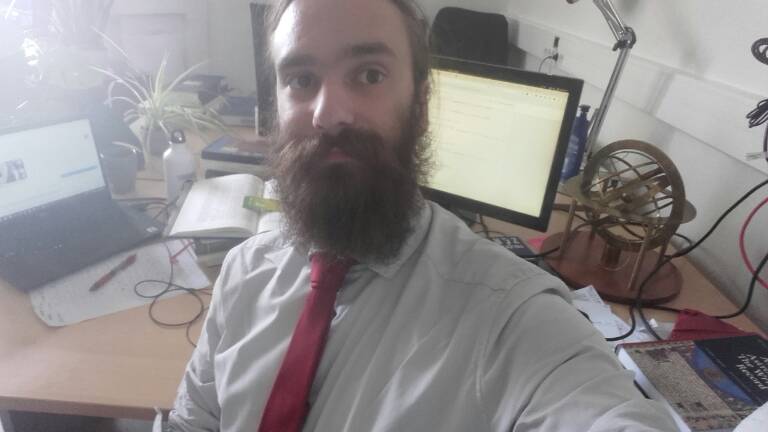
After an initial training in mathematics and computer sciences,
I am currently preparing a PhD in history of matheamtics
at the SPHERE laboratory.
In this capacity, I also take part to diverse
research activities,
notably in relation with projects carried by this research team,
and inside the EIDA project.
I also carry out a teaching assignment
inside the History and Philosophy of Sciences's master program.
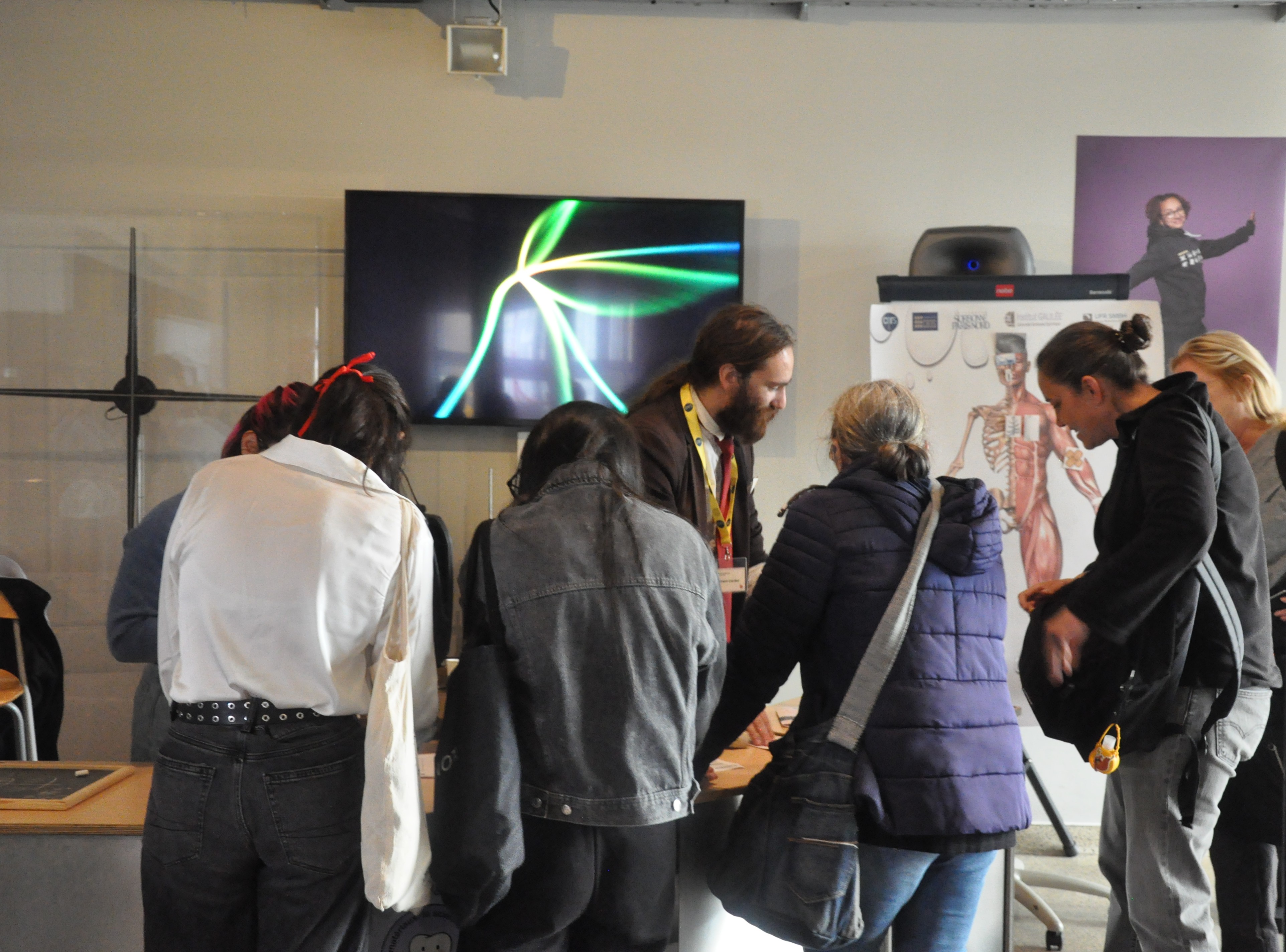
In addition, I also carry out a scientific popularisation work
in relation with the Palais de la découverte.
Finally, I also take a role in the representation of PhD students
inside the laboratory board.
PhD in history and philosophyof science - Université Paris Cité (2023—)
My PhD dissertation pertains to instruments described in Latin texts between the 13th to the 16th century on the topic of eclipse computations. The goal of this research is to think about the notion of instrumented calculation in mathematical disciplines of the quadrivium, and to present a material history of ancient mathematical practices. For this, I am supervised by Agathe Keller in the Sphere laboratory as well as by Matthieu Husson in the Observatoire de Paris.
Master degree in history and philosophy of science - Université Paris Cité (2021–2023)
My Master's thesis, written under the supervision of Matthieu Husson and Sara Confalonieri, pertains to the "Tables of King Alfonso"'s printed editions. These tables were, especially after the 14th century, the main tool Latin-speaking astronomers and astrologers could use to compute planetary positions. My research mainly consisted in showing that people who contributed to the printing of these "Tables of King Alfonso" in Latin did so in a particular economical, political and scientific contexte which lead them to adopt a specific interpretation of the coherence of texts and tables assembled under this title.
Undergraduate training - Université Pairs Diderot / Université Paris Cité (2015–2021)
Bachelor degree in mathematics (2018–2021)
Bachelor degree in compute sciences (second year) (2015–2018)
Training sessions by the doctoral schools
—
The doctoral school 623,
as well as the doctoral college of the university,
propose multiple training programs.
I followed the mandatory online courses
on ethics of research,
and on scientific integrity;
as well as an in-person training on doctoral portfolios,
during which I made this website.
I also took some classes from the program organised by the library on Open Sciences.
forthcomming Clément Cartier, "Printing the Tables of King Alfonso", in Alfonsine Astronomy: Expanding the Scences edited by José Chabás, Richard Kremer and Matthisu Husson (Turnhout: Brepols).
In an article published in 1998,
Emmanuel Poulle and Denis Savoie showed that,
untill the 17th century,
almanacs and ephemerides printed in Latin were computing using parameters
matching those found in the "Alfonsine Tables".
These tables, copied in a (very) large number of manuscripts during the 14th century,
were first pritned in Venice in 1483 by Erhard Ratdolt.
In the following decades, three other printers chose to produce their own editions of the "Tables of King Alfonso" in the Republic:
Johannes Hamman in 1492, Petrus Liechtenstein in 1518, and Luc'antonio Giunta in 1524.
In this chapter, I study the editorial choices made in each of these four endeavrs.
For each of them, I first try to identify which tables and which texts were included in the books.
I then look at the typographical and paratextual features employed by the printer to tie these materials together.
Finally, I analyse how these different elements are ordered in the bound books.
All of this allows me to show an evolution in how actors and actresses who participated to these editions understood the core principles of "Alfonsine Astronomy"
between the end of the 15th century and the beginning of the 16th century.
Thursday, April 23, 2026
« Different Ways of Reading the Treatise on the Albion »
Séminaire
Histoire des sciences, histoire du texte
sur le thème des lecteurs, lectrices et pratiques de lectures
In its earliest witnesses, the Treatise on the Albion, composed around 1326–7,
is a four-part text dealing with an instrument designed to perform all kinds of astronomical computations.
Following a usual denomination for medieval texts dealing with astronomical instruments,
it is often said that these four parts cover both the « construction » and the « use » of the instrument.
In particular, the second part of the treatise is generally understood
as an instruction manual for people who would like to construct a brass albion.
Some manuscripts, however, were copied by people who claimed to already have a version of the instrument in their hands,
and who clearly wanted to work with the one they already had rather than building their own.
John North, who published a critical edition of the text in 1976,
assumed that these copies may have been produced as an act of devotion,
by people who may have been unable to grasp the full intentions of the original author.
In an article published in 2019 (« « I found this written in the other book »: Learning Astronomy in Late Medieval Monasteries », Churches and education vol. 55: 129–144), however,
Seb Falk, suggests a different interpretation for the mathematical mistakes observed in some witnesses.
He argues that the production of what is now manuscript Laud Misc 657 of the Bodleian Library in Oxford,
was made as an act of learning by John of Westwyck, the monk responsible for this copy.
Starting from this conclusion, I would like to propose reading the so-called « instructions » of the second part of the treatise
through the lenses of the theory of textual acts developed in this seminar a few decades ago.
My goal in this presentation would be to argue that the Treatise on the Albion was actually meant as a highly polysemic work,
producing different acts depending on the context in which it was to be read.
The Treatise on the Albion was written
by the Benedictine scholar Richard of Wallingford
during the last year of his stay in Oxford, in 1326–1327.
It is a Latin text which describes an instrument
regrouping all the computational possibilities
offered by other astronomical instruments available at the time,
into one material object (al[l]-by-on[e]).
In the earliest complete witnesses,
this treatise is usually divided into four parts.
The first part is a sequence of 23 “propositions” (conclusiones),
typically including 15 diagrams which can be described as more “geometrical”,
in a way that needs to be discussed.
The second part is divided into 30 chapters (capitula),
describing the “composition” of the instrument itself,
typically accompanied by 14 different diagrams.
Finally, the last two part, which contain no diagrams,
present 42 ways to use the instrument (utilitates),
and introduce 17 tables to work with it or to check computations.
John D. North published a critical edition of this text in 1976,
which—as it is often the case—does not include
a proper discussion on diagrams.
However, in a Feltschrift dedicated to Paul Gimpel first published in 2004,
North argued that Richard of Wallingford’s use and mastery of diagrams,
especially expressed in the Treatise on the Albion,
was pivotal in the history of mathematical thought.
North’s argument actually rely on his own reconstruction of diagrams
based on parts 2 and 3 of the text, rather than on manuscripts.
But it does offer an interesting perspective on the “meaning” of diagrams
as a way to think about relations between quantities
in the context of a text which could be said to be,
all at the same time, astronomical, computational and geometrical.
In this talk, I want to focus more specifically
on the diagrams found in the first part of the treatise.
As we should see, North’s idea of what diagrams
were meant to represent in this context sometimes led him
to fix what he understood to be “mistakes” on the part of the scribes,
in ways that clash directly with the practices documented in manuscripts.
Here, I want to focus on these points of tension with the critical edition.
I will try to understand how the diagrams were actually constructed
in various witnesses, and why they differ from North’s expectations.
This monthly seminar,
which I organise with Agathe Keller since 2023,
is articulated around the presentation of a primary sources and of the problems it creates,
followed by a reading of this source, edited and translated.
One session usually lasts up to 3h, directed by confirmed researchers, PhD students, or even Master's students.
The language is generaly English, sometimes French.
Journées jeunes chercheurs et chercheuses
du réseau thématique HiDiM
(Paris, Mar 30, 2026–Apr 1, 2026)
Les journées jeunes chercheurs et chercheuses du réseau thématique HiDiM (Histoire et Didactique des Mathématiques) accueillent des contributions de toutes personnes en thèse (dès la première année) ou ayant récemment soutenu leur thèse, dans les domaines de l'histoire ou de la didactique des mathématiques. Ces journées se tiendront à Paris les 30 et 31 mars, suivies par des journées plénières les 31 mars et 1 avril.
Session of the History of Science, History of Texts seminar on "Readers and reading practices"
(Apr 23, 2026)
À compléter
Séance du séminaire Historie et philosophie des mathématiques sur les "diagrammes"
(May 11, 2026)
Cette séance est organisée en collaboration avec Agathe Keller, Thomas Berthaud et Simon Gentil
As part as my PhD contract,
I carried out 2 teaching assignments of 32h "équivalent TD"
inside the département histoire et philosophie des sciences
of the Université Paris Cité, from 2024 to 2026.
During this assignment, I got to take part into multiple teaching activities,
including tutorial classes, or
the organisation of the human sciences exam for the specific access pathway year for health training programs (PASS).
But I mostly assumed full lectures for the
master histoire et philosophie des sciencesmaster,
on the following topics.
History of Algebra
(2025–2026, 2×3h CM, M1, SB)
Introduction à lʼhistoire des mathématiques
These two sessions of introduction to the history of mathematics
were part of a larger class for the first year of the master's program.
The first of the two took dealt with a controversy around the interpretation of Old Babylonian tablets,
and used this as an opportunity to present the problems related to the edition of the texts,
and the importance of archaeological contexts to understand the mathematical content of the text.
The following session took this as a starting point to explore further the reconstitution
of mathematical practices from texts in Chinese and in Sanskrit.
(2024–2025, 7×3h CM, M2, SC)
Histoire des mathématiques
This whole semester class dealt with the History of Algebra.
I was in charge for the first half of the semester,
which dealt with everything from Antiquity until the Modern Period (c. 17th century).
My part of the class was organised around the reading of sources in their original language
(Akkadian, Chinese, Sansirkt, Arabic, Latin, French and German).
These texts were selected as an opportunity to talk about issues of method,
regarding how to deal with the archaeological context of the sources,
the stakes related to the methods of edition,
the way texts are read, and so on.
History of Computations in Astronomy
This session was part of a larger class dedicated to the topic of "Numbers and Magnitudes".
The goal for this session was to show how sources related to the History of Astronomy
could be used to study such a theme.
I composed the lesson around a collection of documents
from different periods and in different languages,
which constituded multiple case studies.
Students could then choose to write their final essay
on an article which allowed them to dive deeper
into one of the topics explored in the class.
Sciences as seen from Asia
(2025–2026, 1×3h CM, M1, SA)
History of mathematics in South Asia
I made this session in coordination with
Haolin Wang 王浩霖
and Taro Tokutake 徳武 太郎.
We presented an overview of multiple mathematical problems
dealt in Sanskrit texts.
(2024–2025, 1×3h CM, M1, SA)
Sciences in Mesopotamia
This class, made with Adeline Reynaud,
was a general introduction to the history of sciences in the Ancient Middle East.
It was composed around four themes: divination, medicine, mathematics and astronomy.
These were used as case studies to explore the broader methodological question
of characterising the role of "sciences" in ancient sources.
Scientific animations
In addition to my teaching assignemnts,
I also had a position of scientific mediation
in the Mathematics unit of the Palais de la découverte in Paris,
from 2024 until 2026.
As part of this position,
I presented animations in in relation with both Mathematics and History of Mathematics.
Before the beginning of my PhD, I also worked from 2019 until 2023
with the association Planète sciences
as scientific animator,
and I sometimes worked for the Institut Henri Poincaré in Paris
for specific events in 2018 and 2019.
University responsibilities
2025— Conseil du laboratoire SPHERE (Université Paris Cité, Université Paris 1 — Panthéon-Sorbonne et CNRS)