 Image: Clément
 Doctoral research
The Treatise on the Albion was composed in 1326–1327 by the Benedictine monk Richard of Wallingford, during the last year of his stay in the University of Oxford. This text presents an instrument, called al[l]-by-on[e], which merges in one circular brass layout all the materials needed to carry out pretty much any computation useful in astronomy and trigonometry. The goal of my dissertation is to study the practices of instrumented computation described in this text, focusing mostly on the English manuscripts from the 14th century.
Using the Treatise on the Albion as a case study, my dissertation explores general questions related to the history of mathematics:
Material practices of computation (in astronomy)
How can one compute with the Albion? What are the other mathematical instruments involved in the practices associated with this instrument?
Teaching mathematics with instruments in Oxford and St. Albans
What role could the Treatise on the Albion have played in teaching practices developed in the schools of Oxford and St. Albans, especially for the disciplines of the quadrivium? How can this text fit different pedagogical and didactic uses?
Publications
Contributions to collective books
- forthcomming Clément Cartier, "Printing the Tables of King Alfonso", in Alfonsine Astronomy: Expanding the Scences edited by José Chabás, Richard Kremer and Matthisu Husson (Turnhout: Brepols).
-
Abstract
In an article published in 1998, Emmanuel Poulle and Denis Savoie showed that, untill the 17th century, almanacs and ephemerides printed in Latin were computing using parameters matching those found in the "Alfonsine Tables". These tables, copied in a (very) large number of manuscripts during the 14th century, were first pritned in Venice in 1483 by Erhard Ratdolt. In the following decades, three other printers chose to produce their own editions of the "Tables of King Alfonso" in the Republic: Johannes Hamman in 1492, Petrus Liechtenstein in 1518, and Luc'antonio Giunta in 1524. In this chapter, I study the editorial choices made in each of these four endeavrs. For each of them, I first try to identify which tables and which texts were included in the books. I then look at the typographical and paratextual features employed by the printer to tie these materials together. Finally, I analyse how these different elements are ordered in the bound books. All of this allows me to show an evolution in how actors and actresses who participated to these editions understood the core principles of "Alfonsine Astronomy" between the end of the 15th century and the beginning of the 16th century.
Forthcomming (2026)
Seminar and conference presentations
See my publications on the HAL platformSeminars and events I organise
Ongoing seminars
Reading Mathematical and Astronomical Texts
with Agathe Keller
- Description
- Each session of the Reading Ancient Mathematical Texts Seminar opens with the short presentation of a primary source and the mathematical problems it raises, followed by the reading of this source, provided with an edition and a translation. One reading typically lasts 3 hours, mostly filled with constant exchanges where any naive question is welcomed. This allows us to think about the linguistic composition of the text, its philology, etc. I believe the value of this seminar is mostly to un-understand (that is, to “durstand”) the texts, and to bring to light many unsuspected questions they hold. Three hours is never enough to read large chunks of text, but taking this time always brings very rich and inspiring discussions. This richness comes, not only from the intrinsic value of the sources presented, but also by the diversity of participants, with both experienced researchers and beginner students who can bring their expertise based on diverse sources, and who always invite us to look at the texts with new and original perspectives.
- Upcoming sessions
-
- Oct 29, 2026
-
> See more
周 序林, « Methods for measuring a rectangular field in four excavated mathematical books from ancient China »
- Nov 10, 2026
-
> See more
Mia Joskowicz, « Reworking Euclid’s Irrationals at the Turn of the Seventeenth Century »
- Dec 16, 2026
-
> See more
Catherine Ledesert, « Oresme's Questions on Sacrobosco's De Spera »
- Jan 28, 2027
-
> See more
王 浩霖, « Iterated positions in squaring and cubing, based on the Līlāvatīvivaraṇam »
- Feb 25, 2027
-
> See more
Carole Hofstetter, « Degrees and Their Subdivisions in Pachymeres' Astronomy (Syntagma.4) »
- Mar 17, 2027
-
> See more
徳武 太郎, « Reading Śrīdhara’s Collection of Three Hundred (Triśatī): Multiple Manuscripts towards a New Critical Edition »
- Apr 22, 2027
-
> See more
Matthieu Husson, « Verse and prose in the computation of square roots: a reading of John of Murs Quadripartitum numerorum (France, c. 1343) »
- May 13, 2027
-
> See more
Émilie Villey, « To be announced »
- Jun 24, 2027
-
> See more
To be announced, « To be announced »
- Past events
Past events
Session of the History and philosophy of mathematics seminar dedicated to “diagrams”.
Paris, May 11, 2026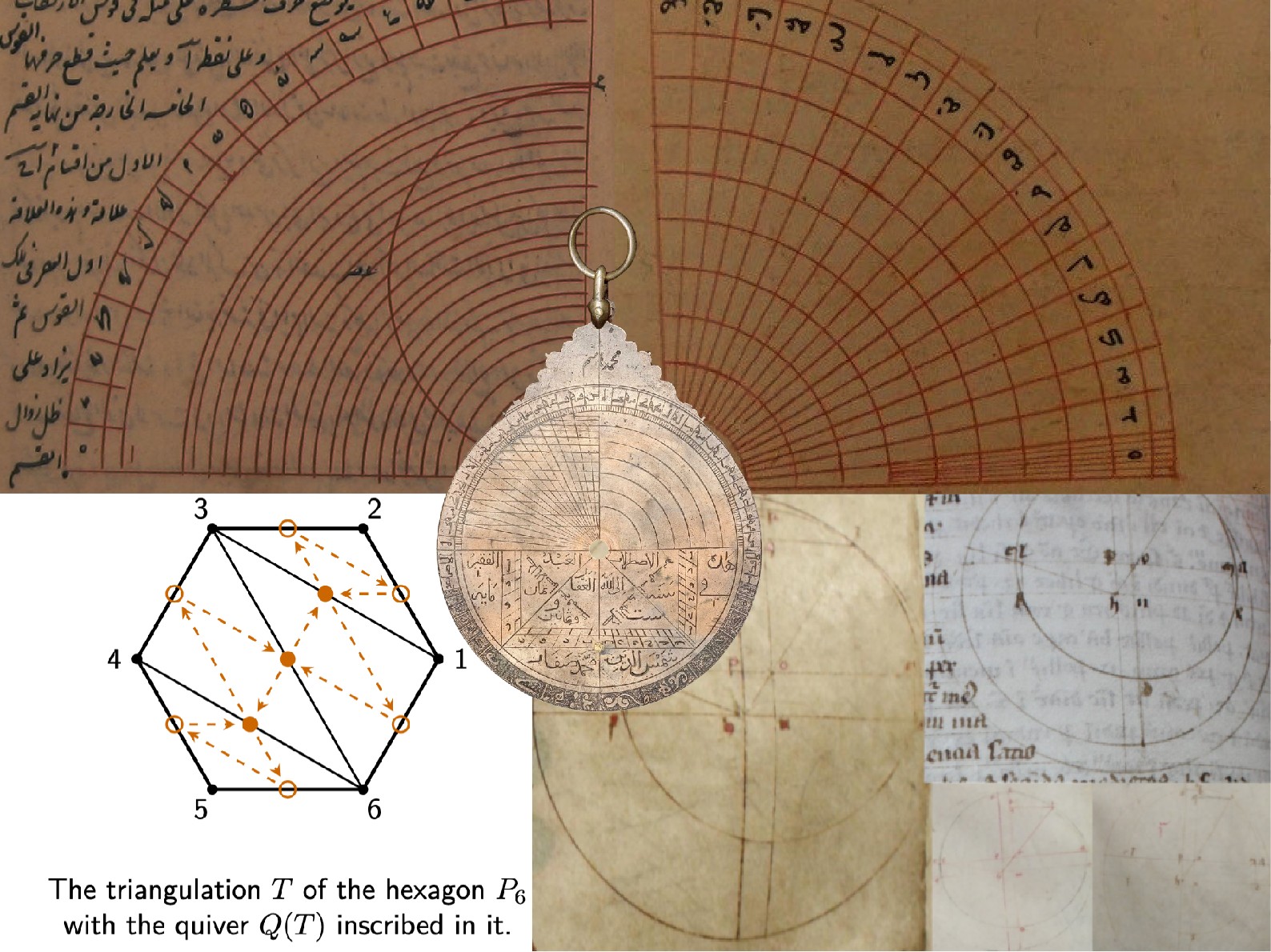
This day was an occasion to gather contributions on the topic of diagrams and procedures in mathematics, spanning from 7th-century Arabic astrolabes until 21st-century cluster theory developed by Lauren Williams, Sergey Fomin and Andrei Zelevinsky's.
> See moreSession of the History of Science, History of Texts seminar on "Readers and reading practices"
Paris, Apr 23, 2026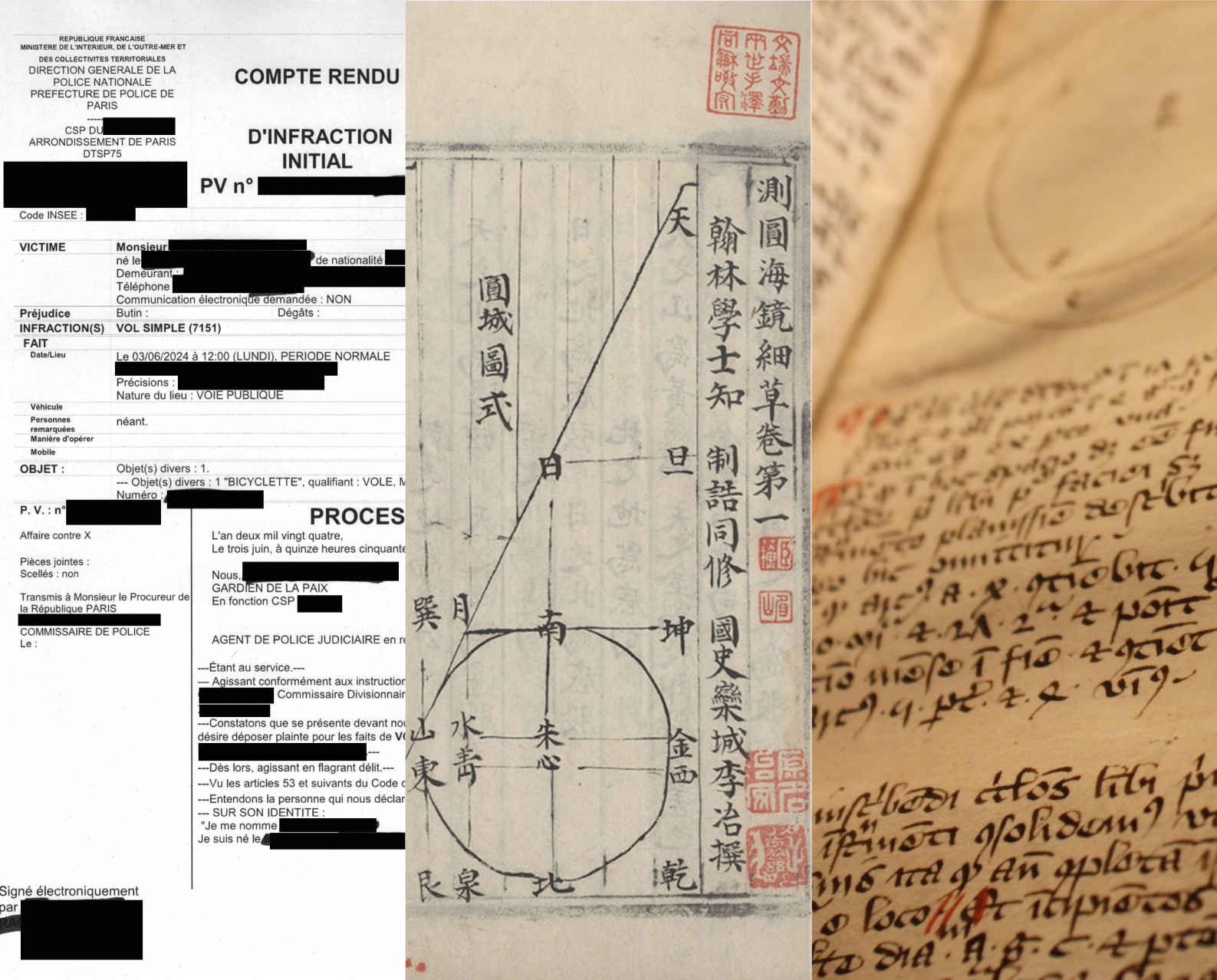
As part of the History of Science, History of Texts seminar, this day was an occasion to focus on the role of readers towards the texts, exploring both linguistics and philological approaches.
> See moreYoung Researchers' Days for the French thematic network on History and Didactic of Mathematics (HiDiM)
Paris, Mar 30, 2026–Apr 1, 2026
The Young Researchers' Days of the HiDiM network (History and Didactic of Mathematics) gathered (pre-)PhD students and young researchers who worked both in history or in didactic of mathematics.
> See moreDISc seminar
Paris, 2024–2025The Interdisciplinary seminar in History, Philosophy and Sociology of Sciences (DISc) is a collaborative space for PhD students of the SPHERE laboratory. We question and discuss methodological approaches used in history, philosophy, epistemology and sociology of sciences. Each session is articulated around one theme related to the works of PhD students in the laboratory.
> See moreDoctoral Days of ED623—Savoirs, Sciences, Éducation
The Doctoral Day of the doctoral school 623 gave PhD students an opportunity to present their research topics and to discuss methodological issues they meet during their thesis. It engages the different disciplinary approaches gathered in our doctoral school (history of sciencees, philosophy, didactic, education sciences, sociology, etc.).
> See moreCollective projects
(2025–2028) Les concepts de science au Moyen Âge tardif (CAPES-COFECUB) | Principal investigator: Aurélien Robert, Marco Aurélio Oliveira da Silva
This French-Brazilian project, led by Aurélien Robert and Marco Aurelio da Oliveira, questions how the concept of “science(s)” was used in late-medieval Latin sources. The project mostly assembles historians of philosophy, and my participation aims to present a point of view based on mathematical and astronomical sources.
> See more(2023—2027) EIDA ("ÉDIter et analyser les Diagrammes astronomiques historiques avec l'intelligence Artificielle" - ANR PRC ANR-22-CE38-0014) | Principal investigator: Matthieu Husson
The collaborative research project EIDA associates a research team in computer vision from the laboratoire d'informatique Gaspard Monge (UMR 8049) and the team of historians of astronomy from the laboratory Systèmes de référence temps-espace (UMR 8630), to think about the role and the circulation of diagrams in the history of astral sciences with the help of artificial intelligence. My doctoral researches on instruments used to compute eclipses allow my to contribute to this project with questions raised by this particular type of diagrams, sometimes articulated, which sometimes make up for a computing instrument.
> See more(2022-2023) ALFA ("Shaping a European Scientific Scence: Alfonsine Astronomy" - ERC n°723085) | Principal investigator: Matthieu Husson
Since 2017, the ALFA project was interested to the diffusion of the Alfonsine Table used by Latin-writing astronomers between the end of the 13th century and the middle of the 16th century. In the making of my master's thesis, I completed an internship in the laboratory Systèmes de référence temps-espace (UMR 8630) to study the printed editions of these tables, at the end of the considered period.
> See more